
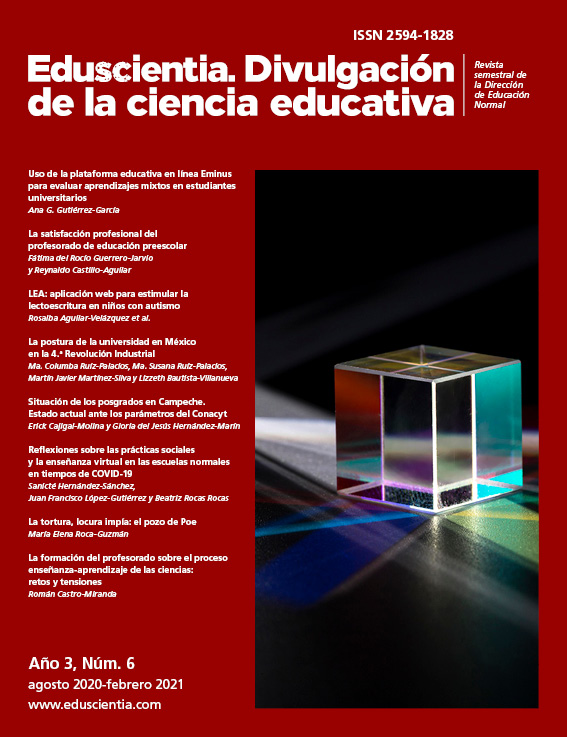
Using the Eminus online educational platform to evaluate blended learning in university students
Keywords:
blended learning, educational innovation, online educational platform, Eminus, university studentsAbstract
Educational innovation is an important factor in the sustainable development of teaching practice. The aim of this study was to transform and systematize a mandatory theoretical-conceptual course for the Psychology at the Veracruzana University (UV), Mexico. A sample of 25 students who were enrolled in the educational experience participated in the study. The course consisted of evaluating blended learning, through a face-to-face course, supported by the online educational platform (Eminus) and the use of anatomical models. The performance of the students was evaluated throughout 16 activities/evaluations. The pass/fail results were compared with four groups of students who took the course with the same teacher (2013-2017). The Eminus platform produced information on the performance of each student both individually and in groups. The number of accesses to the platform was positively correlated with the final average obtained (p < 0.0006). These results will allow the establishment of specific actions, relying on digital resources offered by the UV for teacher improvement.
References
Barrón-Tirado, C. (2020). Propuesta de un modelo híbrido para la UNAM. Recuperado de http://www.economia.unam.mx/academia/inae/images/pdf/PROPUESTADEREGRESOACLASE/Modelo_Hibrido_UNAM.pdf
Butler, A. C., Karpicke, J. D., y Roediger, H. L. (2008). Correcting a metacognitive error: feedback increases retention of low-confidence correct responses. Journal of Experimental Psychology. Learning, Memory, and Cognition, 34(4), 918-928. doi: https://doi.org/10.1037/0278-7393.34.4.918
Contreras, C. M. (1991). La vinculación docencia-investigación. Revista La Ciencia y el Hombre, 7, 7-16.
Dirkx, K. J. H., Kester, L., y Kirschner, P. A. (2014). The testing effect for learning principles and procedures from texts. The Journal of Educational Research, 107(5), 357-364. doi: 10.1080/00220671.2013.823370
Gutiérrez-García, A. G., Granados, D., y Landeros-Velázquez, M. G. (2011). Indicadores de la trayectoria escolar de los alumnos de Psicología de la Universidad Veracruzana. Revista Electrónica Actualidades Investigativas en Educación, 11(3), 1-30. doi: http://www.redalyc.org/articulo.oa?id=44722178009
Gutiérrez-García, A. G., Huerta-Cortés, M., y Landeros-Velázquez, M. G. (2020). Academic procrastination in study habits and its relationship with self-reported executive functions in high school students. Journal of Psychology and Neuroscience, 2(1), 1-9. Recuperado de https://unisciencepub.com/jpn-volume-2-issue-1-year-2020/
Gutiérrez-García, A. G., y Trujillo-Landa, I. (2015). Proyecto aula, estrategia metodológica para la impartición de una experiencia educativa: psicobiología. Revista Electrónica de Psicología, Procesos Psicológicos y Sociales, 11(1-2), 1-42.
Henssen, J. H. A., van den Heuvel, L., De Jong, G., Vorstenbosch, A. T., van Cappellen van Walsum, A. M., Van den Hurk, M., Kooloos, G. M., y Ronald H. M. A (2019). Neuroanatomy Learning: Augmented Reality vs. Cross-Sections. Anatomical Sciences Education, 13(3), 353-365. doi:10.1002/ase.1912
Hernández-Gómez, A. S., Carro-Pérez, E. H., y Martínez-Trejo, I. (2019). Plataformas digitales en la educación a distancia en México, una alternativa de estudio en comunicación. Revista de Educación a Distancia (RED), 19(60), 1-27. doi: https://doi. org/10.21556/edutec.2017.60.798
Hernández-Ruiz, R., y Cruz-Castillo, N. (2012). Eminus: una opción tecnológica para el aprendizaje de lenguas. Repensando y revitalizando la enseñanza-aprendizaje de lenguas: enfoques, contextos, desafíos. Recuperado de https://www.uv.mx/dgdaie/files/2013/04/x4-eminus.pdf
Hernández-Sampieri, S., Fernández, R., y Baptista, M. (2010). Metodología de la investigación. México: McGrawHill.
Muñoz-Muñiz, O., Vázquez-Hernández, M., Cruz-Sánchez, J. S., y Alcántara-López, M. G. (2013). Innovation in teaching-learning process for Pharmaceutical chemistry course. Journal of Teaching and Education, 2(2), 199-206.
Olivar, T., González, M. E., y Rodilla, V. (2010) ¿Cómo valoran nuestros alumnos las estrategias docentes que utilizamos? ARS Pharmaceutica, 51, 102-109.
Passoni, L. I. (2005). Gestión del conocimiento: una aplicación en departamentos académicos. Gestión y Política Pública, 14(1), 57-74.
Pérez-López, I., Delgado, M., y Rivera-García, E. (2009). Efectos de un juego de rol en los conocimientos acerca de la actividad física y la salud en educación secundaria. Revista de Educación, 349, 481-493.
Powell, A., Watson, J., Staley, P., Patrick, S., Horn, M., Fetzer, L., …, y Verma, S. (2015). Blending learning: the evolution of online and face-to-face education from 2008 2015. Promising practices in blended and online learning series. International Association for K-12 Online Learning. Recuperado de https://files.eric.ed.gov/fulltext/ED560788.pdf
Prensky, M. (2010). Teaching Digital Natives: Partnering for Real Learning. London: Corwin.
Ramírez-Valdez, W., y Barajas-Villarruel, J. I. (2017). Uso de las plataformas educativas y su impacto en la práctica pedagógica en instituciones de educación superior de San Luis Potosí. Edutec. Revista Electrónica de Tecnología Educativa, 60, a360. doi: https://doi.org/10.21556/edutec.2017.60.798
Reay, J. (2001). Blended learning-a fusion for the future. Knowledge Management Review, 4(3), 6.
Ruiz-Pimentel, S., Ruiz-Vallejo, S. E., y García-Oramas, M. J. (2010). Investigación y formación de competencias profesionales. Revista Electrónica de Procesos Psicológicos y Sociales, 6(1-2), 1-21.
Shimizu, I., Nakazawa, H., Sato, Y., Wolfhagen, I. H. A. P., y Könings, K. D. (2019). Does blended problem-based learning make Asian medical students active learners?: a prospective comparative study. BMC Medical Education, 19(1), 147. doi: 10.1186/s12909-019-1575-1
Torres-Gastelú, C. A. (2011). Uso de las TIC en un programa educativo de la Universidad Veracruzana, México. Revista Electrónica Actualidades Investigativas en Educación, 11, 1-22.
Universidad Veracruzana. (2008). Estatuto de alumnos 2008. México: Autor. Recuperado de https://www.uv.mx/legislacion/files/2012/12/estatutodelosalumnos2008.pdf
Universidad Veracruzana. (2017a). Evaluación del MEIF 2015-2017: Resultados de las Áreas de Formación Disciplinar, Terminal, de Elección Libre y de la Tutoría Académica en el Modelo Educativo Integral y Flexible. México: Autor. Recuperado de https://www.uv.mx/meif/files/2017/08/Tercer-Reporte-MEIF.pdf
Universidad Veracruzana. (2017b). Manual del facilitador. Eminus. Sistema de Educación Distribuida. Recuperado de https://eminus.uv.mx/eminus/manuales/Facilitador/Manual-Facilitador.htm
Woltering, V., Herrler, A., Spitzer, K., y Spreckelsen, C. (2009). Blended learning positively affects students’ satisfaction and the role of the tutor in the problem based learning process: results of a mixed-method evaluation. Advances in Health Sciences Education: theory and practice, 14(5), 725-738. doi: https://doi.org/10.1007/s10459-009-9154-6
Downloads
Published
Versions
- 2025-07-09 (3)
- 2025-07-09 (2)
- 2020-08-21 (1)
Issue
Section
License

This work is licensed under a Creative Commons Attribution-NonCommercial-ShareAlike 4.0 International License.


